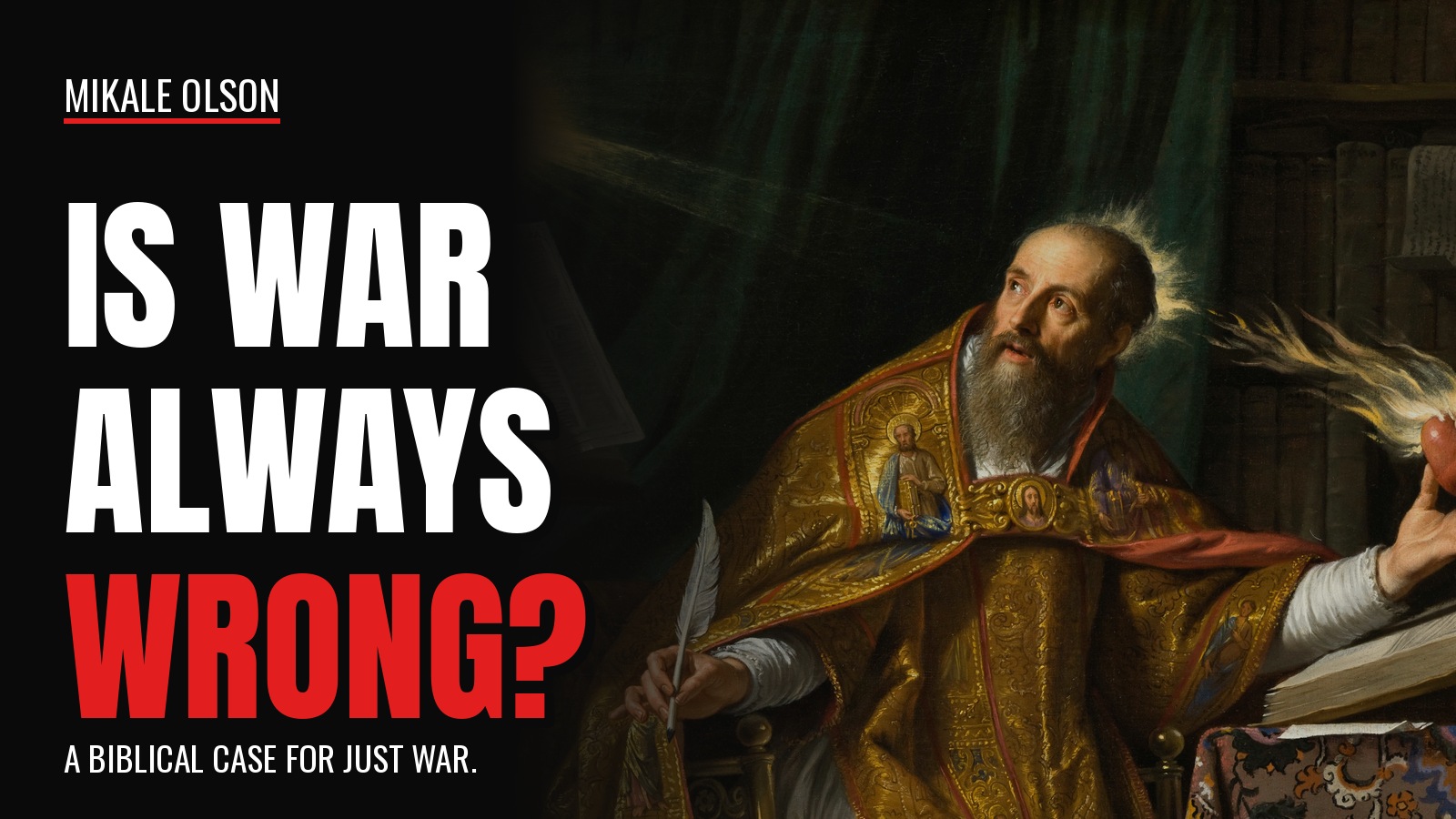
Is War Always Wrong? A Biblical Case for Just War
Scripture does not teach peace at any price. From Romans 13 to Augustine and Aquinas, the Christian tradition asks who the aggressor is, what the alternatives are, and what happens if nobody intervenes. Tucker Carlson's antiwar rhetoric fails that test.
Tucker Carlson has increasingly argued that America should avoid war almost categorically. His criticism of American foreign policy often, at least at the surface (as he wants you to think), centers on the enormous human cost of military conflict, the incompetence of political leaders, and the unintended consequences that frequently follow American intervention overseas.
There is a great deal of truth in those concerns, again, at face value, regardless of whether or not that’s Tucker’s actual position (keep reading to find out).
Christians should not be eager for war. War kills people, destroys families, destabilizes countries, and produces consequences that can last for generations. History provides plenty of examples of governments entering conflicts without clearly defined objectives, exaggerating threats, underestimating costs, or believing military force could accomplish things it ultimately could not.
But there is another danger.
It is possible to become so apparently horrified by war that we begin treating peace, with little thought for justice, as the highest moral good regardless of the circumstances.
That is not the biblical position.
Scripture does not teach that all violence is morally equivalent. It does not teach that killing under every circumstance is murder. And it certainly does not teach that Christians or governments must preserve peace at any cost.
Sometimes force is unjust.
Sometimes refusing to use force allows an even greater injustice to continue.
That distinction is at the heart of what Christians have historically called just war theory.
Government Bears the Sword for a Reason
One of the clearest biblical foundations for the legitimate use of force appears in Romans 13.
Paul describes civil government as an institution established by God for the purpose of restraining evil and administering justice.
Speaking about governing authorities, Paul writes:
“For he is the servant of God, an avenger who carries out God’s wrath on the wrongdoer.” Romans 13:4
Paul also says that the government “does not bear the sword in vain.”
That language matters.
The sword represented the coercive authority of the Roman government, including the authority to punish wrongdoing through lethal force when necessary.
Paul therefore cannot believe that every use of force is inherently sinful. Civil government possesses legitimate authority to restrain evil in ways private individuals do not.
Romans 13 is primarily about domestic civil authority, not international warfare, so we should not pretend Paul is laying out a complete foreign policy doctrine.
But he establishes an important principle.
The use of force by legitimate governing authorities can serve justice rather than constitute murder.
That principle eventually became part of the Christian foundation for just war theory.
The Sanctity of Life Does Not Require Absolute Pacifism
Genesis 9 provides another important biblical principle.
After the flood, God tells Noah:
“Whoever sheds the blood of man, by man shall his blood be shed, for God made man in his own image.”
The reasoning is significant.
Human life is sacred because human beings bear the image of God.
Therefore, murder is extraordinarily serious.
But notice what follows from that principle. The sanctity of human life does not result in God prohibiting every use of lethal force. Instead, the unjust taking of innocent life can itself warrant punishment.
That means the biblical command against murder cannot simply be transformed into a prohibition against every instance of killing.
The moral questions are more complicated.
Who is using force?
Against whom?
For what reason?
By what authority?
Under what circumstances?
And toward what end?
Those questions distinguish murder from legitimate punishment, private revenge from public justice, and aggressive warfare from legitimate defense.
The New Testament Does Not Treat Soldiers as Inherently Immoral
Another interesting piece of evidence comes from John the Baptist.
Soldiers approach John in Luke 3 and ask him what repentance should look like in their profession.
John tells them:
“Do not extort money from anyone by threats or by false accusation, and be content with your wages.”
Notice what John does not say.
He does not tell them to stop being soldiers.
He does not tell them carrying weapons is inherently immoral.
Instead, he tells them not to abuse their authority.
Military service itself is not condemned. The moral concern is how that power is exercised.
Something similar occurs with Cornelius in Acts 10.
Cornelius is a Roman centurion who eventually becomes a Christian. Yet the biblical account contains no command requiring him to abandon military service simply because he has become a follower of Christ.
Neither example by itself proves every aspect of just war theory.
But both create serious difficulty for the claim that Christian ethics requires absolute pacifism.
What Makes a War Just?
Christians eventually developed a moral framework for determining when military force could legitimately be used.
Augustine of Hippo became one of the most important early Christian thinkers on the subject, and Thomas Aquinas later developed the framework more systematically.
Aquinas identified three basic requirements for a just war: legitimate authority, just cause, and right intention.
Later Christian thinkers developed additional criteria.
Traditionally, just war theory distinguishes between two questions.
The first is jus ad bellum, which concerns whether a nation is justified in going to war in the first place.
The second is jus in bello, which concerns how a nation conducts itself once the war has begun.
Several principles emerge from this tradition.
Just Cause
A nation must have a morally legitimate reason for using military force.
Defending a population against invasion is the clearest example.
Stopping grave aggression or protecting innocent people from mass slaughter may also qualify.
Conquest, revenge, economic enrichment, national glory, or simple hatred of another people do not constitute just causes.
Legitimate Authority
Private individuals cannot simply decide to wage wars.
Military force must be authorized by the civil authorities who possess legitimate responsibility for protecting the political community.
This follows naturally from Romans 13.
Government bears the sword. Private individuals do not possess unlimited authority to administer justice on their own terms.
Right Intention
Even when a government possesses legitimate authority and a just cause, its intentions still matter.
The purpose should be the restoration of justice and eventually peace.
A government might possess a legitimate grievance while still fighting primarily out of vengeance, hatred, greed, territorial ambition, or a desire for domination.
Christian ethics does not merely ask whether the enemy has done something wrong.
It also asks what we are trying to accomplish by fighting them.
Last Resort
War should not be the first option.
Diplomacy, negotiation, deterrence, sanctions, and other realistic alternatives should be considered before military force is used.
That does not mean every conceivable diplomatic option must literally be attempted while innocent people are being slaughtered.
Sometimes waiting itself has consequences.
The principle simply means that governments should not choose war casually when reasonable peaceful alternatives remain available.
Proportionality
The expected good accomplished by military action must be proportionate to the destruction likely to result from it.
Suppose military action might prevent a relatively small injustice but will predictably kill hundreds of thousands of innocent people and destabilize an entire region.
That matters morally.
Having a legitimate grievance does not provide unlimited permission to respond however one wishes.
Reasonable Chance of Success
A government should also consider whether the proposed military action can realistically accomplish its objectives.
Sending thousands of people to die in a hopeless conflict merely to demonstrate moral seriousness is not necessarily courageous.
It may simply be irresponsible.
Governments have obligations to the soldiers and citizens whose lives they place at risk.
Discrimination Between Combatants and Civilians
Even when war itself is justified, everything done during the war is not automatically justified.
Military forces must distinguish between legitimate military targets and innocent civilians.
Deliberately targeting civilians, massacring populations, or inflicting indiscriminate destruction violates just war principles.
This produces one of the most important ideas in Christian thinking about warfare:
A just cause does not justify unjust means.
A country could be entirely justified in defending itself against invasion while nevertheless committing immoral acts during that defense.
Both realities can be true simultaneously.
What About Turning the Other Cheek?
Christian pacifists understandably appeal to Jesus’ teaching in the Sermon on the Mount.
Jesus says:
“Do not resist the one who is evil. But if anyone slaps you on the right cheek, turn to him the other also.”
He also commands Christians to love their enemies.
Those teachings cannot simply be ignored.
The question, however, is what kind of behavior Jesus is addressing.
The broader biblical context suggests Jesus is condemning personal vengeance rather than abolishing the government’s responsibility to administer justice.
Romans 12 and Romans 13 are particularly helpful here.
In Romans 12:19 Paul tells Christians:
“Beloved, never avenge yourselves, but leave it to the wrath of God.”
Then, almost immediately afterward, Paul describes government in Romans 13:4 as God’s appointed “avenger” against wrongdoing.
That contrast appears deliberate.
Individuals are forbidden from pursuing personal vengeance.
Government, however, possesses a legitimate responsibility to punish wrongdoing.
Those two principles are not contradictory.
A Christian can forgive someone who wrongs him personally while still believing the justice system should punish murderers.
Likewise, Christians can be commanded to love their enemies while recognizing that governments may sometimes need to stop violent aggressors.
Turning the other cheek does not necessarily mean that a police officer should watch someone murder innocent people without intervening.
And it does not necessarily mean that a government must watch another nation invade its territory and slaughter its population without resistance.
Protecting innocent people can itself be an expression of love for one’s neighbor.
There are Christians who sincerely disagree with this interpretation. Historic Christian pacifist traditions have taken Jesus’ commands to nonviolence much further.
Their arguments should be taken seriously.
But just war theory represents a historically significant Christian attempt to reconcile Christ’s commands concerning personal vengeance with the Bible’s teachings about government, justice, and the restraint of evil.
Refusing to Fight Can Also Carry Moral Consequences
This is where simplistic arguments that “war is bad” begin to fall apart.
Of course war is bad.
The more difficult question is whether war is always worse than the alternative.
Scripture repeatedly emphasizes the responsibility to protect people from injustice.
Proverbs 24:11 says:
“Rescue those who are being taken away to death; hold back those who are stumbling to the slaughter.”
Psalm 82 similarly commands:
“Give justice to the weak and the fatherless; maintain the right of the afflicted and the destitute. Rescue the weak and the needy; deliver them from the hand of the wicked.”
Neither passage is specifically discussing international military intervention.
But they reveal something important about biblical morality.
Passivity in the face of evil is not automatically righteousness.
Imagine that one nation invades another and begins deliberately slaughtering civilians.
A neighboring country might have the ability to intervene.
That does not automatically mean military intervention is required. The government must still consider proportionality, consequences, the possibility of escalation, national responsibilities, and whether intervention could actually succeed.
But neither can that government automatically congratulate itself for remaining peaceful.
Sometimes military intervention makes a situation dramatically worse.
Sometimes refusing to intervene allows the aggressor to continue killing people.
Both possibilities have to be considered.
Restraint can protect innocent life.
Restraint can also abandon innocent life.
That is why Christian ethics requires something more serious than simply asking whether military action involves violence.
Where Tucker Carlson’s Argument Goes Wrong
This is where Tucker Carlson’s rhetoric about war becomes worth examining.
Carlson has spent years criticizing American military intervention, foreign policy establishments, intelligence agencies, and politicians who advocate aggressive action overseas.
Some of those criticisms are entirely legitimate (again, at face value).
There is a perfectly defensible position that says America should be reluctant to go to war.
Governments frequently misunderstand foreign conflicts.
Military interventions produce unintended consequences.
Political leaders can exaggerate public threats for their own personal interests.
Wars can create power vacuums, destabilize entire regions, produce refugee crises, bankrupt governments, and kill enormous numbers of civilians.
A country should therefore demand extremely strong justification before sending its citizens into combat.
That position fits comfortably within just war theory.
In fact, the requirements of last resort, proportionality, right intention, and reasonable likelihood of success create substantial arguments against reckless interventionism.
But Carlson’s rhetoric increasingly seems to do something more than merely argue for restraint.
The broader narrative repeatedly leads his audience toward a much larger conclusion: America itself is the problem.
American power is uniquely corrupt.
American foreign policy is uniquely destructive.
American institutions cannot be trusted.
America’s allies, particularly Israel, are portrayed as instigators dragging Americans into bloodshed, while America’s adversaries are often approached with considerably more curiosity, sympathy, and moral generosity.
That is no longer simply an argument against unnecessary wars.
It becomes a worldview in which American action is presumed guilty before the moral facts of a conflict have even been examined.
The United States has certainly committed foreign policy blunders. Some have been catastrophic. Christians should have no interest in whitewashing them.
But criticism becomes distorted when America is judged by one moral standard while its adversaries are judged by another.
And this is where Carlson’s approach becomes particularly difficult to defend.
Consider Vladimir Putin.
Russia launched its full-scale invasion of Ukraine in February 2022. The war has produced an almost incomprehensible level of death and destruction. By 2026, estimates placed combined Russian and Ukrainian military casualties around two million killed, wounded, or missing. Estimates of Russian military deaths alone run into the hundreds of thousands.
Those casualties did not arise from an American invasion of Russia.
They followed Putin’s decision to invade a neighboring sovereign country.
Russian forces have also repeatedly struck Ukrainian cities and civilian infrastructure.
Yet Carlson traveled to Moscow and gave Putin an extraordinarily accommodating interview in which the Russian president was allowed to present an extended justification for the invasion with relatively little sustained challenge. Carlson later returned to Russia to interview Foreign Minister Sergei Lavrov.
The contrast is striking.
Carlson approaches American and Israeli leaders with intense suspicion about civilian deaths, hidden motives, propaganda, corruption, and military aggression.
Putin, whose own war has resulted in staggering casualties (dwarfing the Israeli/Gaza conflict), frequently receives the benefit of historical context, geopolitical explanation, and sympathetic consideration.
That is a serious inconsistency (blatant lies, I’d argue, from Carlson).
If civilian death is the central moral test by which American foreign policy should be judged, the same test has to be applied to Russia.
If wars that kill hundreds of thousands reveal something evil about the government responsible for starting them, that principle cannot suddenly disappear when Vladimir Putin is responsible for the invasion.
Otherwise the principle is not really opposition to war.
It is selective opposition to Western war.
A similar problem appears in Carlson’s treatment of Iran.
There are perfectly legitimate reasons to oppose an American war with Iran. One can conclude that a particular strike is unnecessary, disproportionate, strategically foolish, or unlikely to improve American security.
But Carlson has often moved beyond criticizing American policy and toward presenting Iran primarily as the victim of American or Israeli aggression.
The Iranian people should not be confused with the Iranian regime. Ordinary Iranians are not America’s enemies simply because they live under that government.
But neither should the Iranian government be romanticized.
Iran’s rulers have violently suppressed their own population, sponsored armed proxies across the Middle East, supported terrorist organizations, threatened neighboring states, and contributed to wars and instability far beyond Iran’s borders.
A serious antiwar philosophy must account for those actions too.
It cannot endlessly catalogue every American or Israeli use of force while treating violence by hostile authoritarian governments as background information requiring endless context.
So, the issue is not whether Carlson literally approves of every authoritarian regime opposed to Washington (which is becoming more the case by the week, it seems).
The issue is the moral framework he increasingly uses when discussing international conflict.
America’s use of power is frequently interpreted as evidence that America is corrupt or destructive. The violence of America’s adversaries is more often explained through their security concerns, historical grievances, fears, or reactions to Western behavior.
That asymmetry matters.
Imagine reversing the standard.
Suppose an American president invaded a neighboring country, initiated a war lasting several years, produced casualties approaching the millions, bombarded cities, annexed territory, and then justified the entire operation through lengthy historical arguments about why the neighboring country was not really entitled to its sovereignty.
Would Carlson treat that president primarily as a misunderstood statesman whose historical perspective deserved a sympathetic hearing?
It seems unlikely.
And that exposes the weakness in the narrative.
A genuinely Christian approach to war cannot begin with the assumption that America is good.
But neither can it begin with the assumption that America is evil.
It must begin with justice.
Who committed the aggression?
What was the threat?
What alternatives existed?
Who is being attacked?
What is the government trying to accomplish?
Is the response proportionate?
Are civilians being deliberately targeted?
What happens if nobody intervenes?
Those questions must apply equally to Washington, Moscow, Tehran, Beijing, Jerusalem, Kyiv, and everyone else.
Anything less is not just war theory.
It is ideological selectivity.
There is an enormous moral difference between invading another country to conquer it and defending your own country from invasion.
There is an enormous difference between murdering civilians and using military force to stop someone who is murdering civilians.
If we reduce the moral analysis to “both sides are killing people,” we erase those distinctions.
The aggressor and the defender suddenly become morally equivalent because both are participating in violence.
Biblical morality cannot work that way.
We must ask who initiated the injustice.
We must ask whether the response is proportionate.
We must ask whether peaceful alternatives exist.
We must ask whether innocent people are being protected.
We must ask what happens if nobody intervenes.
And we must ask whether the force being used is directed toward restoring justice or toward revenge and domination.
Carlson’s strongest arguments concern American interests, failed intervention, reckless elites, and the unforeseen consequences of war.
Those concerns deserve serious attention.
But whenever antiwar rhetoric becomes an assumption that restraint is inherently virtuous, it encounters a serious moral problem.
There is a difference between avoiding an unnecessary war and refusing to confront an aggressor.
There is also a major difference between criticizing your own country and constructing an entire foreign policy worldview in which your own country consistently receives the harshest possible interpretation while its enemies receive the most charitable one.
Christian ethics requires one moral standard for everyone.
Augustine and the Problem of Peace
Augustine understood this tension well.
He did not romanticize war.
He viewed war as one of the tragic consequences of living in a fallen world.
Christians should desire peace.
But Augustine also understood that some forms of “peace” are simply injustice that nobody is resisting.
In The City of God, Augustine observed:
“For every man seeks peace by waging war, but no man seeks war by making peace.”
The statement sounds strange until you understand what he means.
Even conquerors normally do not fight simply because they enjoy endless warfare.
They fight because they want to establish a particular kind of peace afterward.
The real moral question, therefore, is not simply whether someone wants peace.
Everyone claims to want peace.
The question is what kind of peace they want.
A tyrant may desire a peaceful society in which nobody resists his tyranny.
An aggressor may desire peace after conquering his neighbors.
A dictatorship may desire peace after crushing its political opposition.
That is technically peace in the sense that active fighting has stopped.
But it is not necessarily justice.
Christian morality therefore cannot treat peace as merely the absence of conflict.
Thomas Aquinas later developed this idea further by arguing that even legitimate authority and just cause were insufficient if those fighting were motivated by cruelty, hatred, revenge, or lust for power.
The end matters.
The means matter.
The intentions matter.
Old Testament Wars Do Not Give Modern Governments a Blank Check
There is another biblical distinction Christians must make.
The Old Testament contains wars directly commanded by God, particularly during Israel’s conquest of Canaan.
Christians cannot simply point to those wars and conclude that modern governments may wage wars whenever their leaders believe God supports them.
Ancient Israel occupied a unique place in redemptive history.
Israel was a covenant nation governed through direct divine revelation.
The conquest of Canaan occurred within that specific theological and historical context.
Modern governments do not possess Israel’s covenant status.
The United States is not ancient Israel.
Neither is Russia, Britain, Ukraine, Iran, Israel, or any other contemporary nation.
Modern governments therefore cannot claim the same direct divine mandate given to ancient Israel.
Instead, their actions must be evaluated according to broader biblical principles concerning justice, legitimate authority, protection of innocent life, punishment of wrongdoing, proportionality, and restraint.
That distinction is important because governments have repeatedly justified violence by claiming divine approval.
Christian theology should make us extremely cautious about rulers claiming that God has personally authorized their geopolitical ambitions.
Neither Militarism Nor Pacifism Is Enough
The strongest biblical position is not militarism.
Christians should not glorify war.
There is nothing inherently virtuous about bombing another country, defeating an enemy, or demonstrating military strength.
War represents the horrifying consequences of human sin and political failure.
But the strongest biblical position is not absolute pacifism either.
Scripture recognizes legitimate governing authority.
It recognizes the government’s responsibility to restrain evil.
It distinguishes murder from legitimate punishment.
It places enormous moral importance on protecting innocent people from violence.
Sometimes using force is unjust.
Sometimes failing to use force permits injustice.
That means the moral question cannot simply be:
“Will people die if we go to war?”
People may also die if nobody stops the aggressor.
The real questions are harder.
Is there a just cause?
Is the proper authority acting?
Are peaceful alternatives realistically available?
Is the proposed response proportionate?
Can the objective actually be accomplished?
Are civilians being protected?
Is the goal justice and peace, or revenge and domination?
And what are the likely consequences of doing nothing?
That framework forces Christians to resist two equally simplistic impulses.
One is the temptation to believe military power can solve every foreign policy problem.
The other is the temptation to believe refusing military force automatically places us on the moral high ground.
Neither position is sufficient.
War should always be approached with enormous seriousness because human beings made in the image of God will die.
But preserving peace cannot become an absolute principle that requires innocent people to submit indefinitely to violent aggressors.
Sometimes restraint is wisdom.
Sometimes restraint is cowardice.
Sometimes intervention is reckless.
Sometimes intervention is necessary.
And sometimes the loudest critic of war is not applying an antiwar principle consistently at all. He is applying one standard to his own country and another to its adversaries.
Christian political ethics cannot permit that double standard.
The question is not whether America is always right. It plainly is not.
The question is whether America, Israel, Russia, Iran, China, Ukraine, or any other nation is acting justly in the particular circumstances before us.
The biblical goal is not peace at any price.
It is peace governed by justice.