The War That Came Home
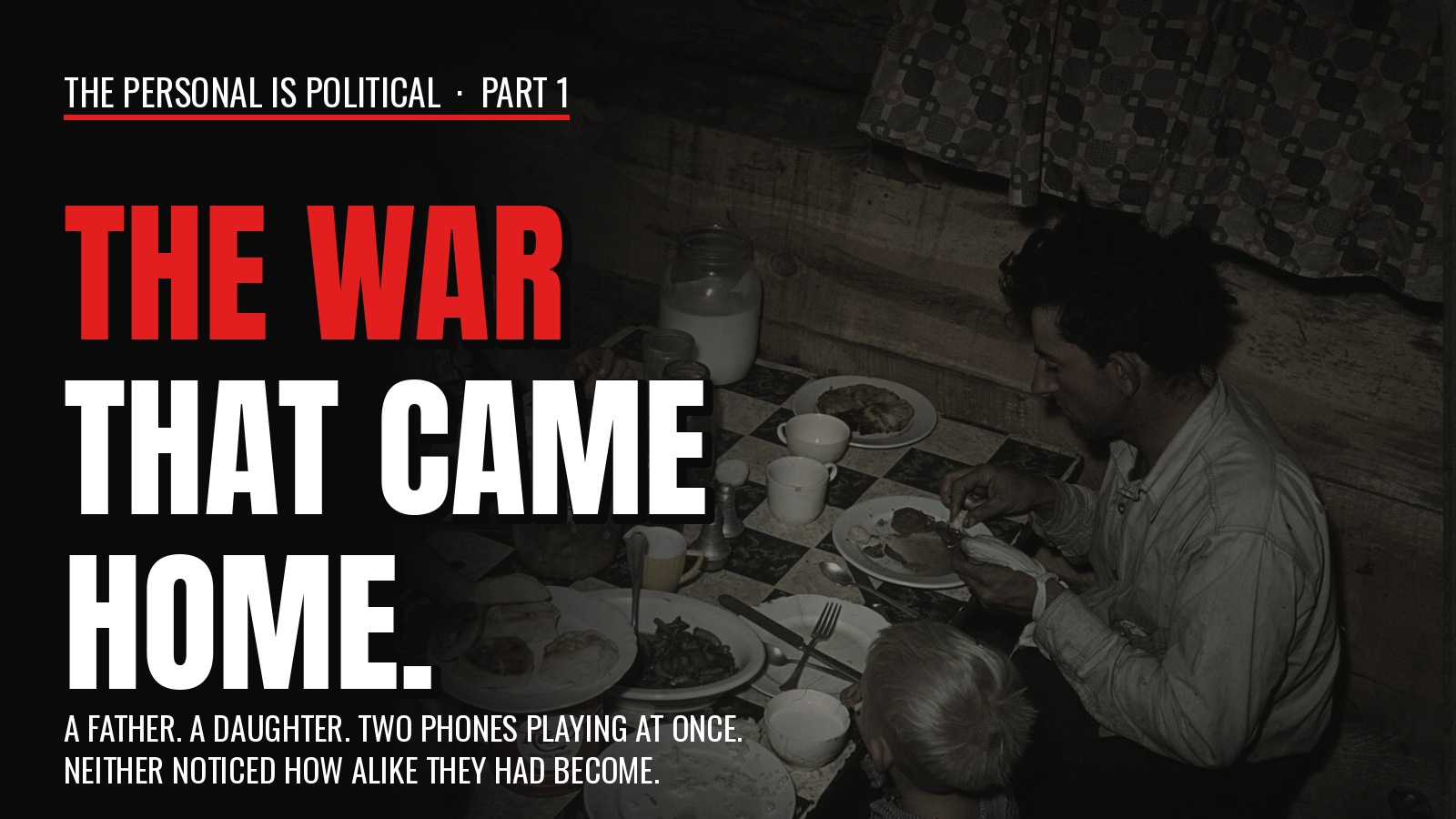
A father, a daughter, and two phones playing at once. Part one of The Personal Is Political, a five part series on how the woke left and the woke right came to resemble each other.
The Personal Is Political, part one of five.
The first time he noticed something was wrong, his daughter looked exactly as she had when he dropped her off at college several months earlier.
She was home for a break during the school year, standing beside him in the kitchen while he made coffee. He was telling her a funny story about a Black guy at work, an old friend who had gotten himself into a ridiculous situation.
“Dad, you can’t say that.” “Say what?”
She explained that his language was problematic. He laughed, thinking she was teasing him. She wasn’t.
What followed was a lecture about race, privilege, and the harm caused by people who refused to examine their biases. He tried explaining that the man was his friend. She informed him that having Black friends didn’t absolve him of racism.
He stared at her. This was the little girl who used to follow him everywhere, who had spent half her childhood in the garage helping him fix things. He had worked hard to give her a comfortable life and paid for her liberal arts education because she wanted to help people and apparently that was the way to do it.
Now she was explaining that his success, their home, and even the life he had provided her were products of an oppressive system.
He asked what had happened to her. She asked why he was so resistant to accountability. Neither understood why the other was being so cruel.
Over the next few years, the changes were harder to miss. Her long hair was cut short, then dyed blue, then buzzed. There were new piercings, new identities, and the vocabulary to go with them. But it was her face that troubled him most.
The girl who once looked at him with adoration now regarded him with contempt, her expression hard and tired, as though managing his endless offenses were an exhausting burden. Eventually, she grew so icy that they stopped speaking altogether. For the next two years, she didn't come home during break.
She had arrived at college wanting to be a good person. By her second year she understood goodness as something that required constant vigilance. She had learned to see her upbringing as a source of unearned privilege for which she must atone. To be truly good, she was obligated to confront the attitudes that sustained it, especially in the white man closest to her. After all, if she couldn't hold her own father accountable, what good was all that education?
He started searching the internet for answers.
He found other parents whose children had accused them of bigotry or turned family gatherings into political tribunals. He listened to podcasts at work and watched videos after dinner. At least he wasn't alone.
He also discovered Charlie Kirk. The campus clips struck a nerve. Kirk went straight into the places where the father felt he had lost his daughter, invited hostile students to the microphone, and challenged their arguments. He was doing what Dad wished he could do: standing firm in his convictions without giving up on the people across from him.
In his favorite clip, a transgender student with blue hair and facial piercings approached Kirk's microphone and asked why he was there.
Kirk explained that when people stop talking and lose their human connection, violence becomes easier to justify. He wanted a culture where people could disagree without resorting to violence.
The student challenged him: wasn't his speech itself a form of emotional violence? Kirk pushed back. Wasn't the point of free speech to hear things that made us uncomfortable? The student said it didn’t make him uncomfortable. It made him angry.
The father sent the clip to his daughter, hoping she might recognize something of their own predicament. She replied with an article calling Kirk a dangerous white supremacist.
Not long afterward, on September 10, 2025, Kirk was shot and killed while speaking at Utah Valley University.
According to court documents, Tyler Robinson admitted to the shooting in messages to his transgender romantic partner. He reportedly told his father that Kirk spread too much hatred, while his mother described his increasingly left-leaning politics and support for gay and transgender rights.
To the father, the resemblance to his daughter's world was unmistakable. Here was another young person who regarded Kirk as an embodiment of hatred and, according to the messages attributed to him, believed some hatred could not be negotiated away.
The man who had tried to keep the conversation going had been killed in the middle of one.
But the father soon found himself listening less to the evidence against Robinson and more to Tucker Carlson and Candace Owens.
He knew them as familiar voices from Kirk's world, people who publicly described themselves as his friends. Before Kirk's death, he had watched them face accusations of antisemitism and admired what he understood as Kirk's loyalty to them.
The controversy had reminded him of his own experience. He didn't fully understand the arguments, but he recognized the accusations, the demands for accountability, and the implication that disagreement revealed some hidden prejudice.
Here we go again, he had thought. Someone asks an uncomfortable question, and suddenly they're hateful.
He wished someone had stood up for him like that when his daughter began calling him a racist. Because he associated Carlson and Owens with Kirk, and because he identified with what he perceived as their mistreatment, he trusted them.
After the assassination, he followed their commentary closely. Their questions and allegations cast suspicion on Kirk's associates, his organization, and people he had counted among his friends.
Some of it initially troubled him. But what if the people who had accused Carlson and Owens of antisemitism really were trying to silence them? He had already seen what looked to him like the same tactics that had torn his family apart. Why should he trust them now?
He started sharing podcast episodes on Facebook. At first, he posted them with a simple invitation to listen. Soon he was spending his evenings in the comments, defending Carlson and Owens as genuine friends of Kirk who were brave enough to pursue the truth.
When someone challenged their claims, he took it personally. He knew what it felt like to be called a bigot for asking questions. He wasn't going to let that happen to them.
He grew convinced that these trusted voices had uncovered a terrible secret about Kirk's death, an injustice that powerful people wanted buried. They weren't going to let Charlie die without answers. They would expose the truth and demand justice, and he would do his part.
Before long, he was repeating antisemitic conspiracy theories himself. He began treating criticism of Carlson and Owens by Jewish commentators as evidence of the very oppression the podcasters had alleged. His suspicions expanded from particular individuals to Jewish donors, the Israeli prime minister, and eventually Jews as a whole.
The father barely noticed how far his thinking had traveled. Every argument in the comments left him more invested in defending the public figures he trusted and the allegations they promoted. He had started out grieving a man who believed in keeping the conversation open. Now he spent his evenings attacking the people that man had called allies, convinced he was defending Kirk's legacy.
During her final year of college, she came home for one last break.
“Why do you keep defending Charlie Kirk online? He was a bigot who promoted hatred. People have a right to defend themselves. And now you’ve been radicalized by conspiracy theories.”
“That’s rich coming from someone who got brainwashed at college.”
“You’re literally blaming Jews for everything.”
“I’m asking questions. Apparently that’s not allowed anymore.” She accused him of repeating talking points. He accused her of doing the same.
Both reached for their phones.
“Just watch this,” they said, almost simultaneously.
They pressed play. Two competing voices filled the room, each trying to explain what the other had gotten wrong. They turned up the volume, talked over the videos, and argued about what the other wasn't hearing. Eventually, they stopped trying to make themselves heard at all.
They sat across from each other, listening to strangers explain why the person they loved most couldn't be saved.
Even though noise had filled the room the conversation had stopped. The daughter believed she was fighting oppression. Her father believed he was exposing it. Neither noticed how much they had come to resemble one another.
For millions of Americans, some version of this dinner has become painfully familiar. Families are estranged, friendships have collapsed, and people who once understood one another now seem to inhabit entirely different realities. Many are left wondering whom to trust, what to believe, and how the people they love became strangers.
This story illustrates how two people on opposite sides of the political divide can arrive at remarkably similar ways of understanding the world, each convinced they are fighting oppression and awakening the other to the truth.
This five-part series examines how the rise of the woke left and, more recently, the woke right has reshaped our identities, relationships, and understanding of the world. We will trace the intellectual roots of the ideology underlying wokeness, from Marxism to the revolutionary feminist declaration that “the personal is political,” and examine how similar frameworks of grievance and division have historically been exploited for ideological subversion.
We will then explore how these ideas have taken on new forms within the American right, where the movement dubbed the woke right increasingly mirrors the critical consciousness and conspiratorial thinking it claims to oppose.
The series culminates in the controversy surrounding Charlie Kirk’s assassination, where these seemingly opposing worlds intersect, offering a revealing case study of the ideological forces we have traced throughout the series.